
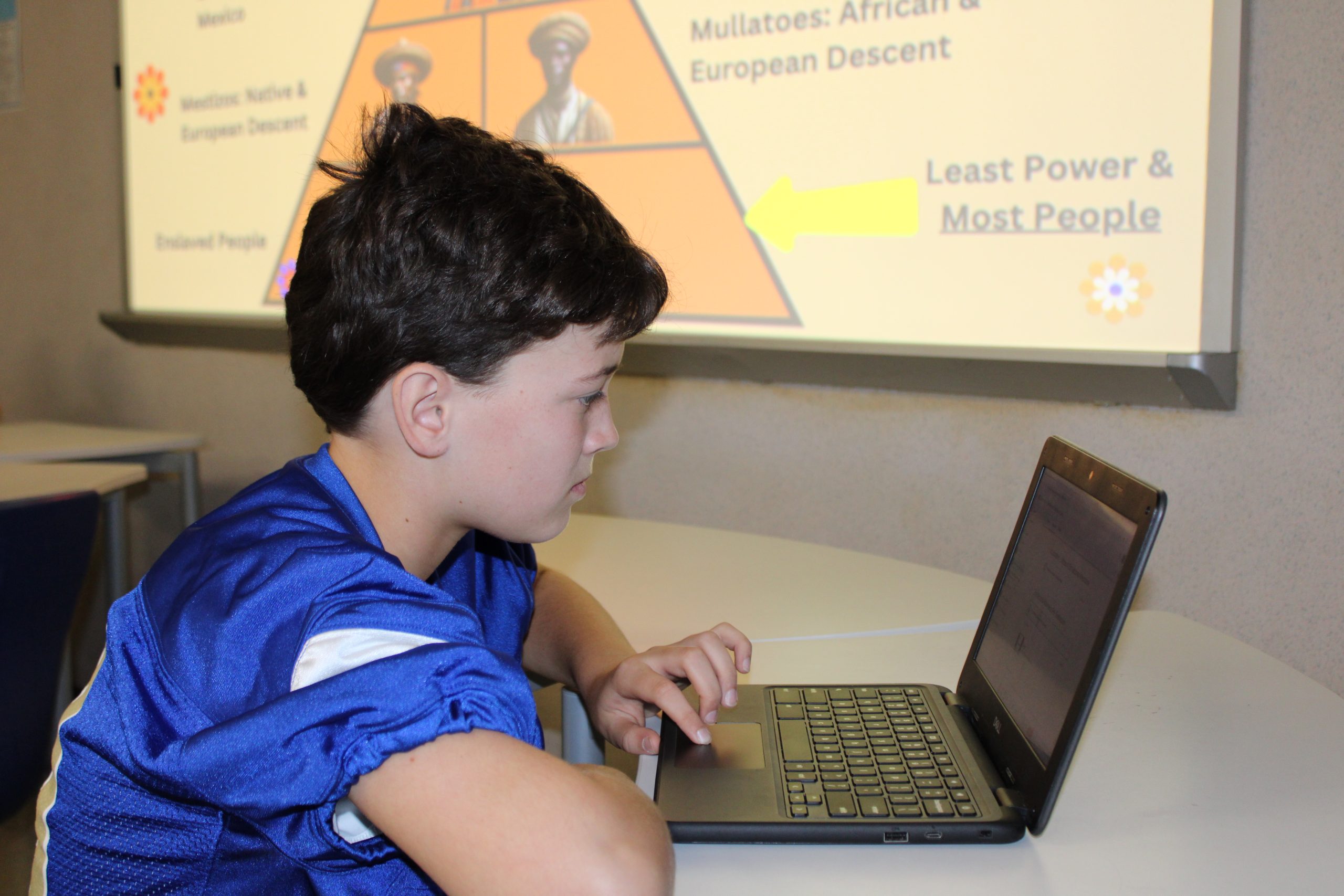
At Alamo Heights Junior School, two types of history are taught: U.S. history and Texas history. While both are essential parts of a student’s education, they are taught in different ways. We spoke to two Mules teachers about their approach to teaching history and the differences in their methods.
U.S. History
U.S. history is a main subject at Alamo Heights Junior School, offering exciting classes with various teaching styles, languages, and course levels.
“I do all eighth grade and one seventh grade, and Mr. Priewe does all seventh grade and one eighth grade,” said Sr. Morales. Many students have Sr. Morales for eighth-grade Spanish U.S. history, while others have Mr. Priewe for seventh-grade English Texas history. The remaining students take U.S. history in English with Ms. Mendoza.
Sr. Morales includes many projects in his curriculum. For example, he says, “The U.S. history project we are going to do is a cereal box in this class.” Students are eager to participate in the different projects offered in his class.
While some students excel in U.S. history, others may struggle. Sr. Morales observes, “I think students struggle the most with critical thinking, the ability to focus, and while they know the basics, like the First and Second Amendments, they have trouble applying it.”
Sr. Morales utilizes various resources to teach U.S. history. He explains, “We use slides, docs, books, articles, and just whatever we can get our hands on.” He also integrates technology, stating, “I use videos regularly.”
Texas History
Texas history is another significant subject at Alamo Heights Junior School, focusing on events that shaped the state. Teaching Texas history requires strong storytelling skills to make the events engaging for students.
“In Texas history, to effectively teach, you have to be a good storyteller,” said Mr. Miller, a sixth-grade social studies teacher who has taught Texas history in the past. Texas history teachers aim to make the material exciting to leave a lasting impact on their students.
Mr. Miller adds, “You have to make events from a textbook that are, like, a couple of hundred years ago relevant and exciting.” This highlights the importance of bringing historical events to life through storytelling.
Mr. Miller also employs unique strategies to engage students. “I would play, like, soundtrack music in the background as I’m telling the stories,” he explains. He would time the music to coincide with shifts in the story’s mood, enhancing the learning experience.
Sr. Morales briefly mentioned the types of projects done in Texas history, noting, “In Texas history, those projects are more models, whereas in U.S. history, we don’t use models as much.”
The Verdict: How Are They Taught Differently? What Are the Similarities?
So, are the two history classes taught differently, or are their teaching methods similar? The answer is both. There are differences and similarities in how U.S. and Texas history are taught.
U.S. history at Alamo Heights Junior School is a core subject offered in English and Spanish. It includes advanced/GT and grade-level courses. The class features diverse projects, extensive resources, and unique teaching methods.
Texas history, on the other hand, focuses on past events in the state. Teachers often use models as projects and incorporate music to engage students through storytelling.
In conclusion, Texas history projects typically involve models, while U.S. history projects offer more variety. Texas history teachers use music as a teaching tool, whereas U.S. history teachers use a range of resources, from articles to videos. Both subjects require students to memorize historical events, highlighting a key similarity in their learning process.


Leave a Reply